
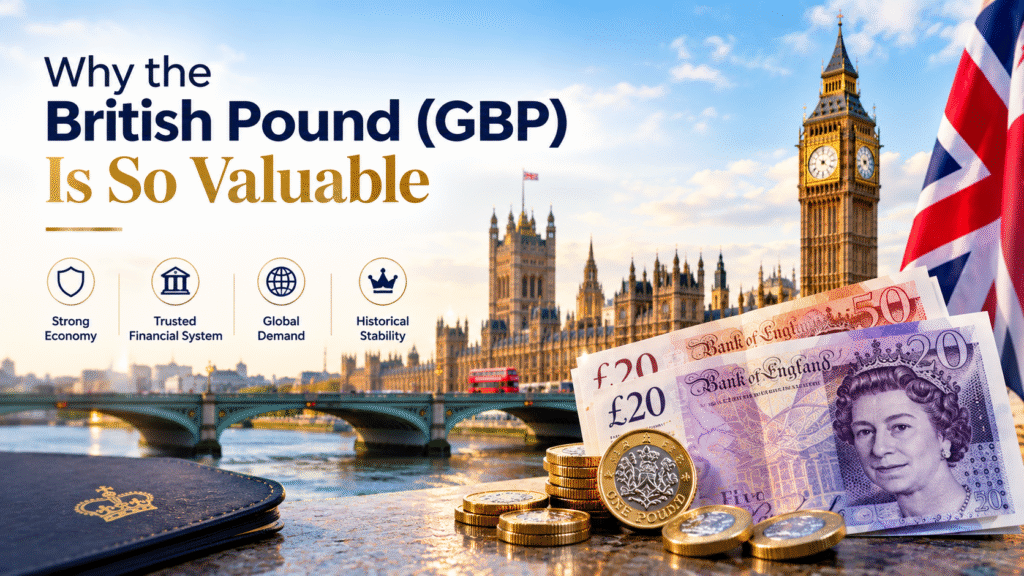
The British Pound is one of the most recognizable currencies in the world – and one of the most expensive. A single British Pound buys more than one US Dollar, more than one Euro, and far more than 100 Japanese Yen. For many people, that raises an obvious question: why is the pound worth so much? And does a high nominal value actually mean anything?
The answers reveal a fascinating story about history, economics, and how currency value actually works.
First, Let’s Clarify What “Valuable” Actually Means
When people say the British Pound is “valuable,” they usually mean one of two things:
- High nominal value – 1 GBP buys more than 1 unit of many other currencies
- Economic strength – the UK’s economy is strong, stable, and respected globally
Both are true for GBP – but they’re actually separate things, and it’s important to understand the difference.
A currency’s nominal value (the number of units you get per exchange) is largely historical and arbitrary. Japan’s Yen is worth about 0.007 USD per unit, but Japan is still the world’s third-largest economy. Hungary’s Forint requires roughly 350 units to buy one Euro – not because Hungary’s economy is weak, but because Hungary never redenominated its currency.
The British Pound’s relatively high nominal value comes primarily from one decision the UK never made: it never significantly devalued or redenominated its currency the way many other countries did during times of economic stress in the 20th century.
The Historical Roots of the Pound’s Value
The British Pound Sterling is the world’s oldest currency still in circulation – its history stretches back to 775 AD, when Anglo-Saxon King Offa of Mercia introduced a silver penny. One pound of silver was worth 240 of these pennies, giving the pound its name and establishing it as a unit of real, tangible value.
For much of the next millennium, the pound was backed by actual silver or gold. Britain adopted the Gold Standard in 1821, formally pegging the pound to a fixed quantity of gold. This gave the pound exceptional credibility internationally – it was, quite literally, as good as gold.
At the height of the British Empire in the late 19th and early 20th centuries, the pound was the world’s dominant reserve currency – the role the US Dollar plays today. Countries around the world held sterling as the backbone of their foreign exchange reserves. London was the undisputed center of global finance.
This long history of reliability, combined with the institutional strength of the Bank of England (founded in 1694 and one of the world’s oldest central banks), built a deep foundation of international trust in GBP that persists to this day.
Why the Pound Stayed High While Other Currencies Fell
Many currencies that were once comparable in value to the pound lost significant value over the 20th century due to:
- Wartime financing – printing money to pay for World War I and II caused inflation and currency devaluation in many countries
- Redenomination – some countries replaced their currencies with new ones at lower values to simplify large numbers (e.g., Turkey replaced millions of old Lira with new Lira)
- Hyperinflation – countries like Germany (Weimar Republic), Zimbabwe, and Venezuela experienced catastrophic currency collapses
The UK was not immune to economic difficulty – it devalued the pound several times in the 20th century (notably in 1949 and 1967) and was forced off the European Exchange Rate Mechanism in the infamous Black Wednesday of 1992, when speculator George Soros famously “broke the Bank of England.” But even through these events, the pound never collapsed or required a fundamental reset.
The result? Today’s pound retains a high nominal value relative to most world currencies – not because of any single economic miracle, but because of institutional continuity and the absence of catastrophic devaluation over 1,200 years.
What Actually Determines the Pound’s Value Today?
Today, GBP is a free-floating currency – its value is determined by market forces, not gold or government decree. The key drivers of the pound’s value include:
1. Bank of England Interest Rate Decisions
The Bank of England’s Monetary Policy Committee (MPC) meets eight times per year to set the UK’s base interest rate. Higher rates attract foreign investment into UK assets, increasing demand for GBP and pushing its value up. Rate cuts have the opposite effect. These decisions are the single biggest short-term driver of pound movements.
2. UK Inflation Data
The UK’s Consumer Price Index (CPI) is released monthly and watched closely by currency markets. High inflation erodes purchasing power and can weaken GBP – unless the Bank of England responds with rate hikes, which tend to counteract the weakness.
3. UK Economic Growth (GDP)
Strong UK economic growth attracts foreign business investment and tourism, both of which require pounds – increasing demand and supporting GBP’s value. Weak or negative growth has the opposite effect.
4. Political Stability and Policy Clarity
The pound is sensitive to UK political developments. The most dramatic recent example was Brexit: when the UK voted to leave the EU in June 2016, GBP fell approximately 10–15% against both USD and EUR within days – one of the largest single moves in major currency history. Political uncertainty is a genuine risk factor for GBP.
5. Global Risk Sentiment
Unlike the US Dollar or Japanese Yen, GBP is not typically considered a safe-haven currency. During periods of global market stress, investors tend to sell GBP (along with other risk-sensitive assets) in favor of USD or JPY. This means GBP can weaken during global crises even if the UK itself is unaffected.
Does a High-Value Pound Help or Hurt the UK?
This is a question economists genuinely debate. Here’s the balanced view:
A Stronger Pound Is Good For:
- Importers – UK businesses importing goods from abroad pay less in pound terms
- UK consumers – imported goods (electronics, food, fuel) are cheaper
- Travelers from the UK – their pounds go further abroad
- UK companies paying foreign staff or suppliers – lower costs in pound terms
A Stronger Pound Is Bad For:
- UK exporters – British goods become more expensive for foreign buyers, reducing competitiveness
- UK tourism industry – the UK becomes more expensive for foreign visitors
- UK manufacturers competing globally – higher costs relative to competitors in weaker-currency countries
The Bank of England doesn’t explicitly target a particular GBP level – its mandate is price stability (around 2% inflation). But currency value is always in the background of economic policy decisions.
GBP vs Other Major Currencies – A Quick Snapshot
| Currency Pair | Approximate Rate | What It Means |
|---|---|---|
| GBP/USD | ~1.27 | 1 pound buys about $1.27 |
| GBP/EUR | ~1.17 | 1 pound buys about €1.17 |
| GBP/JPY | ~190 | 1 pound buys about ¥190 |
| GBP/AUD | ~2.00 | 1 pound buys about A$2.00 |
| GBP/CAD | ~1.75 | 1 pound buys about C$1.75 |
Rates fluctuate daily – check our live GBP converter for current rates.
Brexit’s Lasting Impact on GBP Value
No discussion of the pound’s value is complete without addressing Brexit. The 2016 referendum result and subsequent years of negotiation caused persistent GBP weakness – particularly against EUR – that has not fully recovered.
Pre-Brexit (before June 2016), GBP/EUR typically traded around 1.35–1.40. In the years since, it has generally traded in the 1.10–1.20 range – a structural decline of roughly 10–15% that reflects the ongoing economic uncertainty and trade friction created by leaving the EU single market.
Some economists argue this lower level better reflects the UK’s reduced trade integration with its largest partner. Others believe GBP will recover as post-Brexit trade patterns stabilize. The debate continues – and so does the volatility.
The Bottom Line: Why GBP Is “Valuable”
The British Pound is valuable for a combination of reasons:
- Historical continuity – 1,200 years without a catastrophic devaluation or currency reset
- Institutional strength – the Bank of England is one of the world’s most trusted central banks
- Economic scale – the UK is one of the world’s top 6 economies
- Global financial hub – London remains one of the world’s premier financial centers
- Reserve currency status – GBP is still the third-most held reserve currency globally
Its high nominal value relative to most currencies is a legacy of this long track record – not a daily policy target. Whether it stays at current levels depends on UK economic performance, Bank of England decisions, and the evolving post-Brexit landscape.
Check the current GBP exchange rate against all major currencies with our free GBP converter.
CurrencySwitchNow is not a financial advisor. Exchange rates fluctuate – always verify before making financial decisions.