
If you’ve ever Googled an exchange rate, used an app to check how much your money is worth abroad, or wondered why the number keeps changing – you’ve already interacted with a currency converter. But how exactly does it work? Where does the data come from? And why are some converters more accurate than others?
This guide explains everything you need to know about currency converters – in plain English.
What Is a Currency Converter?
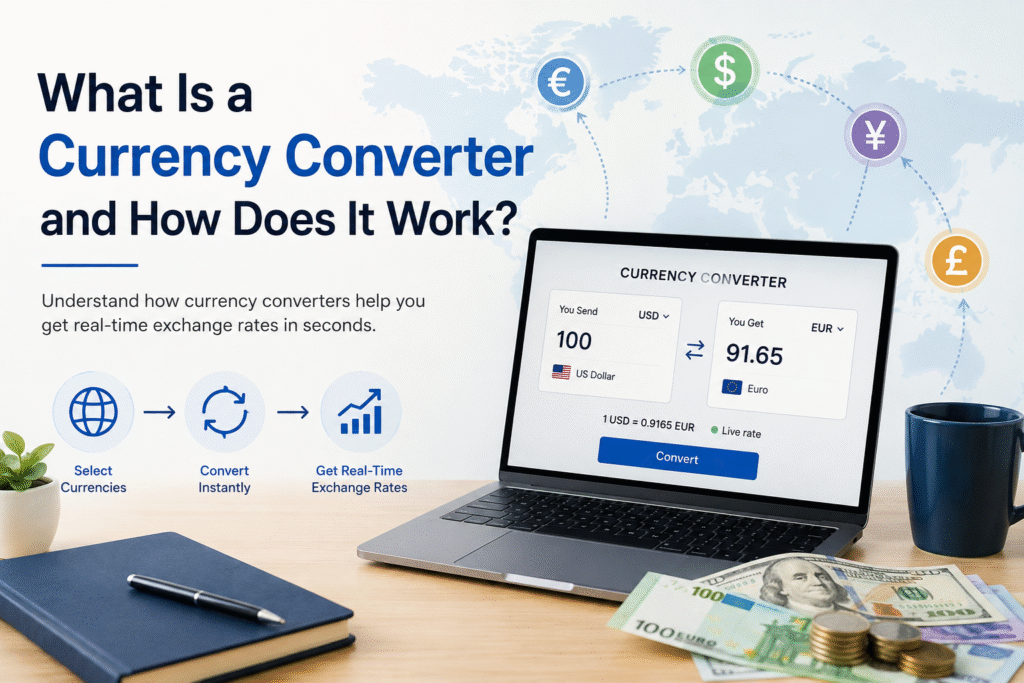
A currency converter is a tool that tells you how much one currency is worth in terms of another, based on current exchange rates. You enter an amount in one currency, select a target currency, and the converter instantly shows you the equivalent value.
For example: “How much is $500 USD worth in Japanese Yen right now?” A currency converter answers that in seconds.
Currency converters are used by:
- Travelers checking how far their money will go abroad
- Online shoppers comparing prices from international retailers
- Freelancers who receive payment in foreign currencies
- Businesses pricing products for international customers
- Investors tracking the value of foreign assets
- Anyone sending or receiving money internationally
They range from simple single-purpose tools to sophisticated platforms that track dozens of currencies simultaneously.
Where Does the Exchange Rate Data Come From?
This is where it gets interesting. Exchange rates don’t come from any one single source – they are determined by the global foreign exchange market, better known as forex or FX.
The Forex Market
The forex market is the largest financial market in the world, with over $7.5 trillion traded every single day. It operates 24 hours a day, five days a week, across financial centers in London, New York, Tokyo, Sydney, Hong Kong, and Frankfurt.
In the forex market, banks, financial institutions, hedge funds, corporations, and governments constantly buy and sell currencies. The price at which any currency trades – the exchange rate – is determined by the continuous interaction of supply and demand across all these participants.
There is no central exchange building or single official price source. Instead, exchange rates emerge from the collective activity of millions of transactions happening simultaneously around the world.
The Mid-Market Rate
The mid-market rate (also called the interbank rate or spot rate) is the midpoint between the highest price a buyer is willing to pay for a currency and the lowest price a seller is willing to accept. It represents the “true” or “real” exchange rate – unaffected by any bank’s markup or service fee.
This is the rate that appears on Google, our free currency converter, financial news sites, and most reputable converter tools. It is the reference point against which all exchange offers should be measured.
How Currency Converters Access This Data
Currency converters pull live exchange rate data from one or more of the following sources:
- Forex data providers – companies like Open Exchange Rates, Fixer.io, XE, and CurrencyLayer aggregate real-time forex market data and supply it to apps and websites via an API (a connection that delivers data automatically)
- Central bank rates – some converters use official rates published by central banks (like the Federal Reserve or European Central Bank), though these are updated less frequently than live market rates
- Financial data services – Bloomberg, Reuters, and similar services provide institutional-grade real-time rate feeds
The best currency converters connect to live forex data feeds and update rates every few seconds or minutes. Simpler converters may update less frequently – sometimes only once per day – which means their rates can be slightly out of date.
How Often Do Exchange Rates Change?
Exchange rates change constantly during market hours – every second, in fact, as new transactions occur in the global forex market. Major currency pairs like USD/EUR, USD/GBP, and USD/JPY can move dozens of times per minute during busy trading sessions.
That said, the scale of these moment-to-moment changes is usually very small – often less than 0.01% per move. The changes that matter for travelers and businesses tend to accumulate over hours, days, or weeks.
Bigger moves happen around:
- Central bank announcements (Fed, ECB, Bank of England, Bank of Japan rate decisions)
- Economic data releases (inflation reports, jobs data, GDP figures)
- Geopolitical events (elections, conflicts, trade disputes)
- Market sentiment shifts (risk-on vs. risk-off moves)
Why Do Different Converters Show Different Rates?
You might notice that Google shows a slightly different rate than your bank’s app, which shows a different rate than a currency exchange bureau. Here’s why:
1. Data Source and Update Frequency
Converters that pull from live professional forex feeds will show rates closer to the real market price. Converters using less frequent data feeds or central bank rates may lag behind.
2. Bid-Ask Spread
The forex market has a bid price (what buyers will pay) and an ask price (what sellers will accept). The mid-market rate is the midpoint. Some converters show the mid-market rate; others build in the spread, which gives a slightly different number.
3. Markup Added by Banks and Services
Banks and exchange bureaus don’t show you the mid-market rate – they show you their rate, which includes a markup that becomes their profit. That’s why your bank’s exchange rate always looks worse than Google’s rate. It’s not an error – it’s intentional.
4. Timing
Rates move constantly. Two converters checked even seconds apart may show fractionally different rates simply because the market moved between the two lookups.
What’s the Difference Between a Currency Converter and a Money Transfer Service?
| Currency Converter | Money Transfer Service | |
|---|---|---|
| What it does | Shows you exchange rates | Actually moves money between accounts |
| Examples | Our converter, Google, XE | Wise, OFX, Revolut, bank wire |
| Cost | Free to use | Fees apply to transfers |
| Rate shown | Usually mid-market | Varies – some use real rate, some add markup |
| Result | Information only | Money arrives in recipient’s account |
A currency converter tells you what the rate is. A money transfer service actually executes the conversion and sends the funds. The best transfer services (like Wise and OFX) use rates very close to the mid-market rate – making it easy to compare what you see on a converter to what you’ll actually pay.
How to Use a Currency Converter Effectively
Most people use currency converters only to check a quick rate. But you can get much more value with a few simple habits:
1. Use It as Your Benchmark
Before any currency exchange, transfer, or international purchase – check the mid-market rate on our converter first. This gives you a reference point to evaluate whether the rate you’re being offered is fair.
2. Track Rate Trends
If you’re planning a large transfer or purchase in a foreign currency, check the rate daily for a week or two. You’ll quickly get a sense of whether the current rate is high or low relative to recent history – helping you decide when to convert.
3. Convert Both Ways
If you’re a freelancer pricing your services for an international client, use the converter to check both directions: what does $X USD look like in their currency, and what does their rate look like in yours? This helps you price competitively without undervaluing your work.
4. Check Before You Shop Internationally
When buying from international retailers online, check the converter before checkout. If the retailer charges in a foreign currency, you’ll know exactly what you’re actually paying in your home currency – including any potential card foreign transaction fees.
Why Some Currency Converters Are Better Than Others
When evaluating a currency converter, look for:
- ✅ Live data – rates updated in real time or near real-time, not once a day
- ✅ Mid-market rates – the true rate, not a marked-up rate
- ✅ Wide currency coverage – at minimum all major currencies (USD, EUR, GBP, JPY, AUD, CAD, CHF)
- ✅ Clean, fast interface – results in seconds, works on mobile
- ✅ Transparency – clearly explains where rate data comes from
Our free currency converter covers all major currency pairs with real-time rates – no sign-up, no fees, no hidden markups. Just the rate.
Frequently Asked Questions
Is a currency converter rate the same as what I’ll get at a bank?
No. Currency converters typically show the mid-market rate – the “real” rate. Banks add a markup of 2–6% on top of this rate when you actually exchange money. The difference between what you see on a converter and what a bank offers you is the bank’s profit margin.
How accurate are online currency converters?
Reputable converters that pull from live forex data feeds are highly accurate – typically within fractions of a percent of the actual market rate at any given moment. Converters using older or less frequent data may be slightly behind.
Can I use a currency converter to calculate my taxes on foreign income?
Currency converters give you exchange rates, but tax calculations involving foreign income typically require the official rate published by your country’s tax authority for a specific date. Always consult a tax professional for tax-related currency questions.
Why does the exchange rate on a converter differ from what I get at the airport?
Airport exchange booths apply a significant markup to the mid-market rate – often 8–15%. The rate on a converter shows the real rate; the airport rate reflects both the market rate and the booth’s profit margin added on top.
The Bottom Line
A currency converter is a window into the global forex market – a real-time reflection of what one currency is worth relative to another. Understanding how it works helps you make smarter decisions whenever money crosses borders.
The key insight: the mid-market rate you see on a converter is your baseline. Any exchange offer – from a bank, bureau, or transfer service – should be measured against it. The closer to the mid-market rate you get, the less money you lose to unnecessary fees and markups.
Use our free currency converter to check live rates anytime – no sign-up required.
CurrencySwitchNow is not a financial advisor. Exchange rates fluctuate – always verify before making financial decisions.