
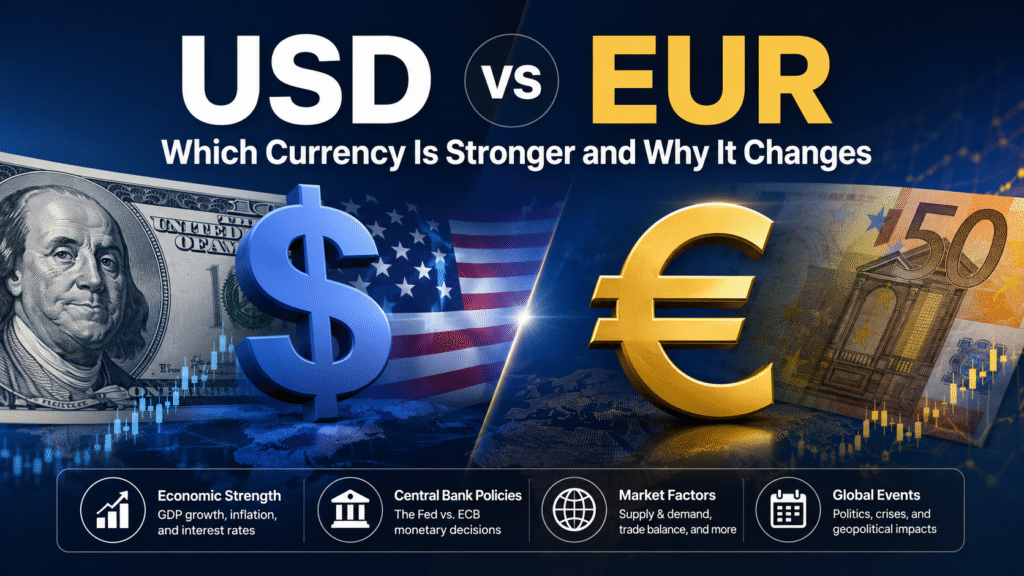
If you’ve ever checked an exchange rate and wondered why the Euro seems to be worth more than the Dollar – or noticed that the gap between them keeps shifting – you’re not alone. The USD vs EUR relationship is the most watched currency comparison in the world, and understanding it can save you money, help you time international transfers, and give you genuine insight into the global economy.
Let’s break it down clearly.
Which Is Worth More – USD or EUR?
In simple terms, 1 Euro is typically worth more than 1 US Dollar. As of recent trading, 1 EUR buys approximately $1.05–$1.12 USD depending on the day. That means if you’re converting Dollars to Euros, you’ll get slightly less than what you put in (in unit terms).
But here’s what many people misunderstand: a currency being “worth more” per unit doesn’t mean the country is richer or its economy is stronger. The Euro’s higher nominal value is partly a result of how it was originally set up when launched in 1999 – designers intentionally pegged it above the Dollar. Japan’s Yen, for example, is worth a fraction of a US cent, but Japan is still the world’s third-largest economy.
What actually matters is purchasing power – how much you can buy with each currency in its home market – and the direction of exchange rate movement, which tells you which currency is gaining or losing strength over time.
A Brief History of USD vs EUR
The Euro launched on January 1, 1999 at an exchange rate of approximately 1 EUR = $1.18 USD. Within two years, it had fallen dramatically – hitting a low of around $0.83 USD in 2000 as markets were skeptical about the new unified currency’s future.
From there, the Euro staged a remarkable recovery:
- 2002–2008: EUR strengthened steadily against USD, peaking near $1.60 in July 2008 – its all-time high – driven by a weakening US Dollar amid the housing bubble
- 2008–2014: EUR/USD fell as the Eurozone debt crisis engulfed Greece, Spain, Italy, and Portugal
- 2015–2021: Persistent ECB stimulus and low interest rates kept EUR relatively weak against USD
- 2022: EUR/USD reached parity (1:1) for the first time in 20 years – driven by the European energy crisis following Russia’s invasion of Ukraine and aggressive Federal Reserve rate hikes
- 2023–2024: EUR recovered as the ECB raised rates aggressively to fight inflation
This history shows one thing clearly: the relationship between USD and EUR is never fixed. It changes constantly – sometimes dramatically – based on economic and political events.
What Drives the USD vs EUR Exchange Rate?
1. Interest Rate Differentials – The #1 Driver
The most powerful force moving USD/EUR is the interest rate gap between the US Federal Reserve and the European Central Bank.
When the Fed raises rates, the US Dollar typically strengthens because higher rates attract foreign capital seeking better returns on US bonds and savings. When the ECB raises rates faster than the Fed, EUR gains. The direction and pace of rate changes – and crucially, the expected future path of rates – matter as much as the rates themselves.
This is why traders pay enormous attention to Fed and ECB meeting announcements, speeches by Fed Chair Jerome Powell, and statements from ECB President Christine Lagarde.
2. Inflation Data
High inflation erodes a currency’s purchasing power over time. When US inflation runs hotter than European inflation, USD tends to weaken relative to EUR – and vice versa. Monthly CPI (Consumer Price Index) reports from the US and Eurozone are among the most market-moving economic releases of the year.
3. Economic Growth (GDP)
A stronger economy attracts investment. When the US economy is growing faster than the Eurozone, the Dollar tends to strengthen. When Europe outperforms expectations, EUR gains. Quarterly GDP reports and forward-looking indicators like PMI (Purchasing Managers’ Index) surveys influence EUR/USD constantly.
4. Geopolitical Events
Wars, elections, and political crises affect both currencies. The Russian invasion of Ukraine in 2022 devastated EUR – Europe’s energy dependence on Russia created immediate economic pain. US presidential elections, European parliamentary elections, and geopolitical flashpoints can all move EUR/USD significantly.
5. Risk Sentiment
The US Dollar is the world’s primary reserve currency and is seen as a safe haven in times of global stress. When investors are frightened – during a financial crisis, pandemic, or geopolitical shock – they often sell risky assets and buy USD, pushing it higher regardless of economic fundamentals.
EUR vs USD Parity – What Does It Mean?
When EUR/USD hits 1.00 (parity), it means 1 Euro buys exactly 1 US Dollar. This is a significant psychological milestone but not a magic number. The last time it happened before 2022 was in 2002 – and when it hit parity in July 2022, it made headlines worldwide.
For travelers and businesses, parity is significant because:
- Americans traveling to Europe find European prices feel roughly equivalent to US prices
- Europeans traveling to the US lose the purchasing power advantage they normally have
- Businesses with cross-Atlantic transactions face reduced predictability in their revenue and costs
How EUR/USD Affects You Practically
For Travelers
If you’re American visiting Europe, a stronger USD means your dollars go further – European hotels, meals, and shopping feel cheaper. A weaker USD makes Europe feel expensive.
If you’re European visiting the US, a stronger EUR gives you more purchasing power – US goods and services feel like a bargain. A weaker EUR makes the trip more expensive.
For Online Shoppers
Buying from European retailers when the USD is strong means you’re effectively getting a discount. Buying from US retailers when EUR is strong is favorable for European shoppers. Exchange rate movements directly affect the real cost of international online shopping.
For Freelancers and Businesses
If you receive payment in EUR but live in the US (or vice versa), exchange rate swings directly affect your income. A 5% move in EUR/USD over a quarter can mean thousands of dollars of difference in what you actually receive.
How to Track EUR/USD and Time Your Conversions
- Check our free EUR converter for the current real-time rate
- Set a rate alert on Wise or Revolut – both apps let you set a target rate and notify you when it hits
- Watch for key events – Fed and ECB meeting dates are published months in advance; rates often move sharply around these dates
- For large conversions, consider using OFX which offers forward contracts to lock in today’s rate for a future transaction
Quick Comparison: USD vs EUR at a Glance
| Feature | USD | EUR |
|---|---|---|
| Managed by | US Federal Reserve | European Central Bank |
| Countries using it | USA + several others | 20 Eurozone nations |
| Global reserve share | ~58% | ~20% |
| Daily forex volume | Most traded | 2nd most traded |
| Safe haven status | Yes – primary | Partial |
| Most recent all-time high vs each other | EUR: $1.60 (2008) | USD: Parity (2022) |
The Bottom Line
Neither the USD nor EUR is permanently “stronger” than the other – their relationship shifts constantly based on interest rates, inflation, economic growth, and global events. The Euro is currently worth more per unit than the Dollar, but that gap narrows and widens constantly.
What matters for you:
- Travelers: check the rate before your trip and use a travel card for the best deal
- Businesses: consider hedging large EUR/USD exposures with a forward contract
- Shoppers: take advantage of favorable rates when you spot them
Check the current EUR/USD rate right now with our free currency converter.
CurrencySwitchNow is not a financial advisor. Exchange rates fluctuate – always verify before making financial decisions.