
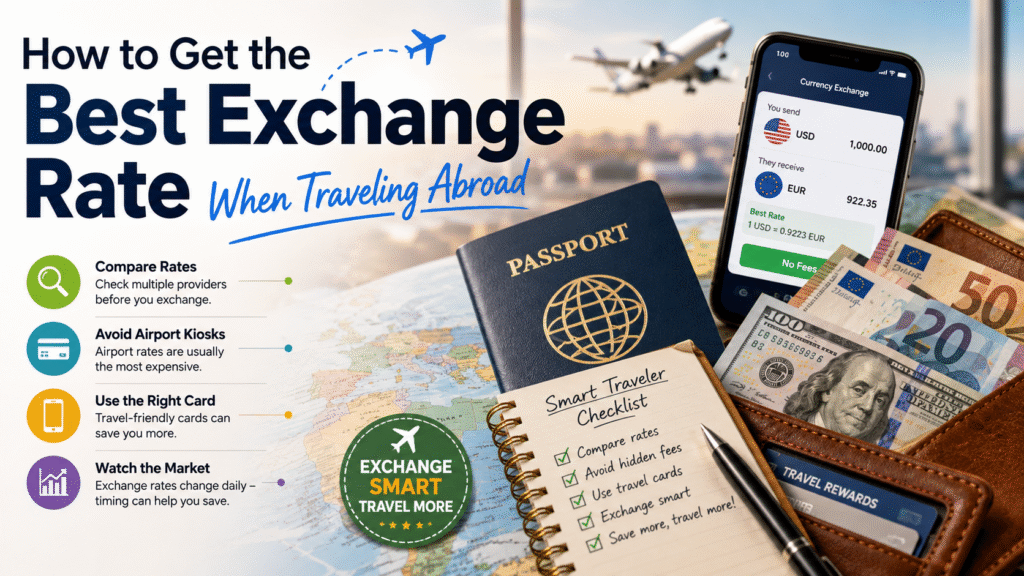
Traveling abroad is exciting—but losing money on poor exchange rates before you even land is a frustrating way to start any trip. The good news? Getting a great exchange rate is not complicated once you know what to avoid and what to use instead. This guide walks you through everything you need to know to keep more money in your pocket every time you travel internationally.
Why Exchange Rates Matter More Than You Think
Most travelers focus on finding cheap flights and hotels—and completely overlook the hidden cost of currency exchange. Yet for a two-week international trip with a $3,000 budget, the difference between a bad exchange rate and a good one can easily cost you $150–$300 before you’ve bought a single meal.
That gap comes from something called the exchange rate markup—the difference between the real mid-market rate and the rate your bank or exchange service actually gives you. Most banks and airport kiosks pocket a 3–6% markup every time you convert money. They rarely disclose this clearly; it simply appears as a worse rate.
The solution is not magic—it’s knowing which services use the real rate and which ones don’t.
The Worst Places to Exchange Currency
1. Airport Currency Exchange Booths
Airport exchange kiosks are convenient, open late, and staffed with helpful people. They are also almost always the worst place to exchange money. Markups of 8–15% above the mid-market rate are common, especially for less popular currency pairs.
People use them because of convenience and last-minute panic. Handle your currency before you get to the airport.
2. Hotel Front Desks
Hotels offer currency exchange as a favor to guests—not as a competitive financial service. Markups of 5–10% are typical.
3. Your Home Bank’s Foreign Currency Service
Many banks offer to order foreign currency for you in advance. Unfortunately, bank exchange rates are rarely competitive. You may pay 3–6% above the real rate, plus potential order fees. For small amounts of emergency cash, it can be acceptable, but it is not a good primary strategy.
4. Dynamic Currency Conversion at ATMs or Stores
When you use a foreign ATM or pay by card abroad, you may be asked whether you want to pay in your home currency. Always say no. Dynamic Currency Conversion (DCC) locks in a rate set by the merchant rather than your bank. Always pay in the local currency and let your card handle the conversion.
Better Ways to Exchange Currency Abroad
1. Use a Specialist Travel Card
A fee-free travel debit card can be one of the best tools for managing travel currency.
- Wise: Converts at the real mid-market rate with a small, transparent fee. It supports 40+ currencies, lets you hold multiple currencies, and works well for multi-country trips.
- Revolut: Offers real exchange rates on weekdays with no markup. Its standard plan allows a set amount of fee-free ATM withdrawals per month and is useful for travelers who primarily use cards.
Both cards are accepted wherever Visa or Mastercard are accepted.
2. Withdraw Cash from ATMs at Your Destination
If you need local currency, withdraw it from an ATM at your destination using your travel card. Use bank-affiliated ATMs when possible, withdraw larger amounts less frequently to minimize per-withdrawal fees, and avoid standalone machines in tourist areas.
- In Japan, 7-Eleven (Seven Bank) ATMs are widely available and accept most foreign cards.
- In Europe, look for ATMs operated by major banks.
3. Use a Specialist Money Transfer Service for Large Amounts
For large payments before your trip, such as an apartment, school fees, or a foreign-account transfer, consider a dedicated money transfer service instead of a bank wire.
- Wise: Handles transfers in 40+ currencies at near mid-market rates.
- OFX: Is suitable for larger transfers, typically $1,000+, and offers forward contracts to lock in a rate for a future payment.
- Revolut: Works well for smaller international transfers with competitive rates.
4. Get Some Local Cash Before You Go—Strategically
Some local cash is useful for small shops, transport, tips, and emergencies. Order through your bank’s online portal for slightly better rates, or withdraw a small amount from an airport ATM using your travel card rather than a currency booth.
5. Monitor the Rate If You’re Flexible
Exchange rates fluctuate daily. If your trip is weeks away and you need to convert a significant amount, monitor the trend using your free currency converter. A 1–2% favorable move on a $2,000 conversion could save $20–$40.
Country-Specific Tips
Europe (EUR)
The euro is highly liquid, so reputable services generally offer competitive rates. Avoid tourist-area exchange booths in Paris, Rome, and Barcelona. ATM withdrawals using a Wise or Revolut card are often a better option for cash.
Japan (JPY)
Japan is cash-heavy. Carry more cash than you would in Europe, and use reliable 7-Eleven (Seven Bank) ATMs. Exchange enough for your first few days before visiting rural areas.
The UK (GBP)
The UK is increasingly cashless, and contactless payments are common in major cities. If you need cash, use ATMs operated by major banks such as HSBC, Barclays, or Lloyds rather than independent machines.
Canada and Australia (CAD/AUD)
Both countries are highly card-friendly. Make sure your card does not charge foreign transaction fees; ATM withdrawals and contactless payments are widely available.
How to Calculate If You’re Getting a Good Rate
- Look up the mid-market rate on your free currency converter or Google.
- Compare it with the offered rate. If it is worse by more than 1%, look elsewhere.
- Factor in fees. A service with a small fee and a real exchange rate is usually better than one with “no fees” but a marked-up rate.
Example: Converting $1,000 USD to Euros
At a mid-market rate of 1 USD = 0.92 EUR, you should receive about €920. If a bank offers 1 USD = 0.87 EUR, you would receive only €870—a €50 difference, roughly $55 USD. With Wise, you might pay a $6 fee but receive about €913, saving nearly $50 compared with the bank.
Quick Reference: Best Options by Situation
| Situation | Best option |
|---|---|
| Everyday spending abroad | Wise or Revolut travel card |
| Withdrawing local cash | ATM at destination with travel card |
| Large international transfer | OFX or Wise |
| Small emergency cash at home | Bank order—acceptable, not ideal |
| Airport exchange booth | Avoid—always |
| Dynamic Currency Conversion at an ATM | Always decline |
The Bottom Line
Getting the best exchange rate is not about finding a secret trick. Get a Wise or Revolut card before your trip, withdraw cash from destination ATMs when needed, always pay in local currency, and avoid airport or hotel exchange services unless it is a genuine emergency.
These steps can help you stay close to the real mid-market rate instead of losing 5–10% through traditional methods. On a $3,000 trip budget, that could leave an extra $120–$270 for experiences rather than exchange fees.
Ready to check today’s exchange rates before your trip? Use our free currency converter for real-time rates on USD, EUR, GBP, JPY, AUD, CAD, and more.
CurrencySwitchNow is not a financial advisor. Exchange rates fluctuate—always verify rates before making financial decisions.