
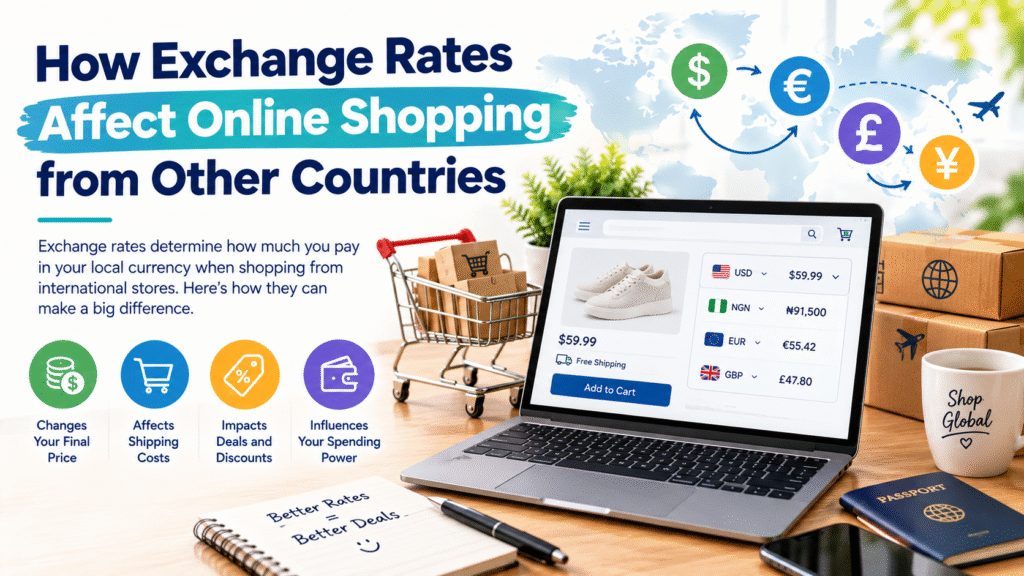
International online shopping has never been more accessible. You can buy from Japanese electronics retailers, British fashion brands, Australian skincare companies, or European luxury goods sellers – all from your couch, all delivered to your door. But there’s a hidden variable that most shoppers overlook: the exchange rate.
The exchange rate between your currency and the seller’s currency directly affects how much you actually pay – and it changes every day. Understanding how it works can save you money, help you spot genuine bargains, and prevent some costly surprises at checkout.
How Exchange Rates Change the Price You Actually Pay
Here’s the fundamental mechanic: when you shop on a foreign website, the price is listed in their local currency. When you pay, your bank or card provider converts your home currency into theirs – at whatever exchange rate applies that day, plus any fees or markup they add.
Example:
You’re buying a jacket from a UK retailer priced at £120.
- If GBP/USD = 1.25, you pay $150 USD
- If GBP/USD = 1.35, you pay $162 USD
- If GBP/USD = 1.15, you pay $138 USD
Same jacket. Same price tag. A $24 difference just from the exchange rate moving. Multiply that across a larger purchase – or a habit of regular international shopping – and the numbers become significant.
The 5 Ways Exchange Rates Affect Your International Shopping
1. The “Favorable Rate” Bargain
When your home currency is strong relative to the seller’s currency, foreign goods are effectively cheaper for you. Many savvy shoppers deliberately buy from specific countries when the exchange rate is in their favor.
For example, when the US Dollar is strong against the British Pound (USD/GBP is high), American shoppers find UK retailers surprisingly affordable – even after accounting for shipping. This is why exchange rate movements sometimes trigger visible spikes in cross-border shopping behavior.
2. Price Fluctuations Without Price Changes
Foreign retailers don’t change their prices because your currency moved – but the real cost to you changes anyway. A Japanese electronics item priced at ¥50,000 costs an American shopper very different amounts depending on the USD/JPY rate:
- At 140 JPY/USD: costs $357 USD
- At 155 JPY/USD: costs $323 USD
- At 125 JPY/USD: costs $400 USD
A $77 swing on a single purchase – entirely driven by exchange rates, not by the retailer changing anything.
3. Hidden Conversion Fees from Your Card
Beyond the exchange rate itself, your credit or debit card may charge a foreign transaction fee – typically 1–3% – on top of the exchange rate conversion. Many shoppers don’t realize this until they see their statement.
To avoid this:
- Use a fee-free travel card like Wise or Revolut for international purchases – both convert at the real rate with no foreign transaction fees
- Check your card’s terms for foreign transaction fees before shopping internationally
4. Dynamic Currency Conversion (DCC) – The Sneaky Checkout Trap
Many international checkout pages offer to show you the price “in your home currency” and let you pay in your own currency instead of theirs. This sounds helpful. It isn’t.
This feature is called Dynamic Currency Conversion (DCC), and it uses the retailer’s (or their payment processor’s) exchange rate – which is almost always significantly worse than the rate your bank would apply. The difference is pure profit for the merchant or payment processor.
Always pay in the local currency of the retailer when given the choice. Let your card or payment service handle the conversion – they’ll almost always do it at a better rate than the merchant’s DCC offer.
5. Return and Refund Complications
When you return an internationally purchased item, the refund is typically issued in the original currency. If the exchange rate has moved between your purchase and your refund, you may receive more or less than you originally paid in your home currency – even if the refund amount in the foreign currency is exactly correct.
This is an often-overlooked risk for large international purchases. If a rate moves 5% between purchase and return, your refund could be worth 5% less in your home currency through no fault of the retailer.
When Is the Best Time to Shop Internationally?
The honest answer: it’s impossible to predict exchange rates with certainty. But here are practical approaches for different situations:
For Regular International Shopping
Don’t try to time the market. Instead, eliminate conversion costs by using a card that charges no foreign transaction fees and converts at the real rate (Wise or Revolut). This ensures you always get the real exchange rate regardless of timing.
For Large One-Off Purchases
If you’re making a significant international purchase – high-end electronics, luxury goods, furniture, artwork – it’s worth monitoring the exchange rate for a week or two before buying. Use our free currency converter to watch the trend. A 2–3% favorable move on a $1,000 purchase saves you $20–$30 with zero extra effort.
For Subscriptions Priced in Foreign Currencies
Many software tools, streaming services, and professional subscriptions are priced in USD or GBP. If you pay in your local currency, the real cost fluctuates with the exchange rate. Consider holding a small amount in the relevant currency (using a Wise multi-currency account) to lock in a favorable rate when you see one.
Country-by-Country Guide: Where Exchange Rates Matter Most
Shopping from US Retailers (USD)
The US Dollar is the world’s most widely used currency for e-commerce. Most major US retailers – Amazon US, eBay US, Etsy, B&H Photo, REI – price in USD. For non-American shoppers, a stronger home currency relative to USD means better value. Check the current USD rate with our USD converter.
Shopping from UK Retailers (GBP)
UK fashion (ASOS, Reiss, Matches), beauty, books, and specialty goods are popular globally. The pound’s fluctuations – particularly post-Brexit – have created periodic bargain windows for international shoppers. Check the GBP converter before a major UK purchase.
Shopping from European Retailers (EUR)
European luxury goods, wines, design products, and specialty foods often cost less purchased directly from European retailers than through international distributors. Check the EUR converter to assess the real cost.
Shopping from Japanese Retailers (JPY)
Japan is a goldmine for anime merchandise, electronics, beauty products, and specialty foods. The Yen’s significant weakening in 2022–2024 made Japanese goods exceptionally affordable for international shoppers – a trend worth watching. Check the JPY converter.
Shopping from Australian Retailers (AUD)
Australian skincare, fashion, outdoor equipment, and specialty products have growing international followings. AUD is sensitive to commodity prices, creating rate fluctuations worth monitoring. Check the AUD converter.
Shopping from Canadian Retailers (CAD)
Canada has excellent outdoor, fashion, and specialty food brands. CAD’s sensitivity to oil prices means the rate can shift meaningfully over weeks. Check the CAD converter.
Practical Tips for Smarter International Shopping
- Use the Right Payment Method: Wise card or Revolut card – both convert at the real mid-market rate with no foreign transaction fees. This alone saves most international shoppers 1.5–3% on every transaction.
- Always Pay in Local Currency: When asked at checkout (or by your card’s app) whether to pay in your home currency or the seller’s currency, always choose the seller’s currency. Paying in your home currency triggers Dynamic Currency Conversion and a worse rate.
- Check the Total Cost Including Shipping and Duties: A great exchange rate can be offset by high international shipping fees or import duties. For EU buyers purchasing from outside the EU, or for buyers outside major trade blocs, always factor in customs and import taxes before deciding a foreign purchase is a bargain.
- Set Rate Alerts for Major Purchases: Both Wise and Revolut allow you to set a target exchange rate and get notified when it hits. If you’re eyeing a significant international purchase, set an alert at a favorable rate and wait.
- Use Our Converter Before You Buy: Before any international purchase, check the current rate on our free currency converter. Knowing the real rate takes 10 seconds and gives you the benchmark you need to evaluate whether the conversion your card or payment service applies is fair.
The Bottom Line
Exchange rates are an invisible but very real factor in every international online purchase. They can make a foreign item dramatically cheaper or more expensive than it appears – and the fees layered on top of conversion rates can quietly add 3–5% to your total.
The smartest international shoppers do three things:
- Use a fee-free card (Wise or Revolut) to eliminate markup and foreign transaction fees
- Always pay in the seller’s currency to avoid Dynamic Currency Conversion
- Check the real rate on our converter before significant purchases
Do these three things consistently and you’ll always know exactly what you’re paying – and you’ll stop losing money to avoidable fees.
CurrencySwitchNow is not a financial advisor. Exchange rates fluctuate – always verify before making financial decisions. Import duties and taxes vary by country.