
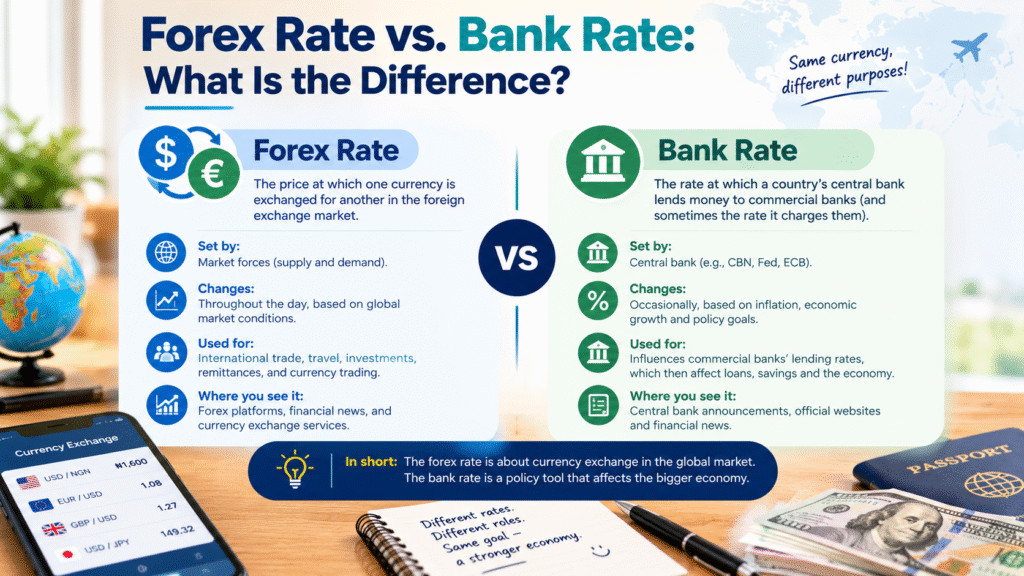
A forex rate describes the value of one currency compared with another in the foreign-exchange market. For example, a USD to EUR rate shows how many euros correspond to one US dollar.
Currency values move because of supply and demand, interest rates, inflation expectations, economic data, trade, political developments, and market sentiment.
A currency converter generally displays a reference rate based on market data. This is useful for estimating value, comparing currencies, and understanding how rates change.
What is the mid-market rate?
The mid-market rate is approximately the midpoint between the price at which financial institutions buy a currency and the price at which they sell it.
It is often used as a neutral reference because it does not represent the exact rate that every consumer will receive. Banks, payment companies, and currency exchanges usually add a margin when providing a conversion.
What is a bank rate?
A bank rate is the exchange rate offered by a bank to its customer. It may be used for:
- Converting money in a bank account
- Sending an international transfer
- Paying with a debit or credit card
- Buying foreign cash
- Receiving money from another country
The bank rate may differ from the market reference rate because the bank may include a spread, service charge, or other cost.
Why bank rates are different
Banks provide a service that involves payment processing, compliance checks, technology, liquidity, and operational risk. The exchange-rate margin helps cover those costs and may also form part of the bank’s revenue.
A bank may display an attractive transfer fee while applying a less favorable exchange rate. For this reason, it is important to compare the final amount received rather than looking at one fee alone.
A simple example
Imagine that the reference value for a payment is USD 1,000 converted into another currency. A bank may use a rate slightly below the reference rate and also charge a transfer fee.
The difference may seem small on one transaction. Over several international payments, however, the combined effect can become significant. The exact result depends on the currencies, payment amount, provider, and timing.
Use Currency Switch Now to estimate the reference value first. Then compare that estimate with the amount your bank or provider says you will receive.
Forex rate, bank rate, and cash-exchange rate
Cash exchanges often use another rate. A physical exchange office must manage notes, inventory, security, rent, and handling costs. Its rate may therefore differ from both the market reference rate and a bank’s electronic transfer rate.
Airport exchange counters may be convenient but can have less favorable rates because of their location and operating costs. Travelers should compare rates before exchanging large amounts of cash.
How to compare rates correctly
When comparing a forex rate with a bank rate, check the following:
- Are both rates for the same currency pair?
- Are they quoted in the same direction?
- Is the rate for buying, selling, sending, or receiving money?
- Are fees included separately?
- Is the rate guaranteed or only an estimate?
- How long will the quoted rate remain valid?
A common mistake is comparing USD to EUR with EUR to USD. These are inverse relationships, so the figures will not look the same.
Frequently asked questions
Is the forex rate the rate I will receive?
Not necessarily. It is usually a reference rate. The provider you use may apply a spread or fee.
Do all banks use the same exchange rate?
No. Banks set their own customer rates and may update them at different times.
Is a zero-fee transfer always cheaper?
No. The provider may recover its cost through the exchange-rate markup. Compare the final amount received.
Why does the rate change during the day?
Currency markets react to new information and trading activity. Rates can change frequently while markets are open.
Final thoughts
The forex or mid-market rate helps you understand the underlying value of one currency against another. The bank rate is the price offered by a particular financial institution after its margin and costs are considered.
Both figures can be useful, but they answer different questions. Use the forex rate as a benchmark, then check the bank’s complete quote before completing an international transaction.
Currency Switch Now provides currency information and conversion tools. It is not a financial advisor. Exchange rates fluctuate, so verify the latest rate before making financial decisions.